V Belt
Umar Farooq Belting Products: Your Trusted Source for Quality V Belts and Fan Belts
Introduction: Umar Farooq Belting Products is a leading name in the industry, specializing in the manufacturing and supply of high-quality V belts and fan belts. With a commitment to excellence and a focus on customer satisfaction, we have established ourselves as a reliable and trusted provider of belting solutions.
Product Range:
- V Belts: Our V belts are precision-engineered to meet the demanding requirements of various industries. Whether it’s industrial machinery, automotive applications, or agricultural equipment, our V belts are designed to deliver optimal performance and durability. We offer a comprehensive range of V belts in different sizes and configurations to cater to diverse applications.
- Raw Edge Cogged V Belts: These belts are designed for high-efficiency power transmission, reducing slippage and increasing overall performance.
- Wrapped V Belts: Known for their flexibility and reliability, wrapped V belts are suitable for a wide range of applications, providing a cost-effective solution for power transmission.
- Variable Speed V Belts: Engineered for applications requiring variable speed control, these belts offer precise and smooth power transmission.
- Fan Belts: Our fan belts are designed to ensure efficient and reliable operation of cooling systems in various applications, including automotive and industrial machinery. We offer a diverse range of fan belts that are known for their durability and resistance to wear.
- Automotive Fan Belts: Specifically designed for the automotive sector, our fan belts provide a dependable solution for engine cooling systems, ensuring optimal performance and longevity.
- Industrial Fan Belts: Tailored for industrial applications, these belts are built to withstand heavy-duty use, making them suitable for large-scale cooling systems in manufacturing environments.
Key Features:
- Quality Assurance: All our V belts and fan belts undergo rigorous quality control processes to ensure they meet the highest industry standards. We use premium materials and advanced manufacturing techniques to guarantee reliability and longevity.
- Customization: Recognizing that different applications have unique requirements, we offer customization options for our belts. Whether it’s a specific size, material, or configuration, we can tailor our products to meet your exact specifications.
- Competitive Pricing: At Umar Farooq Belting Products, we believe in offering competitive pricing without compromising on quality. Our cost-effective solutions make us a preferred choice for businesses seeking reliable belting products.
Our Premium Brands Include:
- Opti Belt (European Brand): Renowned for its precision engineering and durable materials, Opti Belt is a trusted European brand that delivers top-notch V belts and fan belts. We stand by Opti Belt for its exceptional quality and reliability.
- Gates (U.S. Brand): A global leader in power transmission solutions, Gates is synonymous with innovation and longevity. Our collection of Gates V belts and fan belts is designed to meet the highest industry standards, providing efficiency and durability.
- Mitsubishi (Japanese Brand): With a legacy of engineering excellence, Mitsubishi’s belts are recognized for their superior performance and longevity. We bring you a selection of Mitsubishi V belts and fan belts to cater to your diverse needs.
- Bando (Japanese Brand): Bando is a trusted name in the industry, known for manufacturing high-performance belts. Our range of Bando belts offers reliability and efficiency, making them an ideal choice for various applications.
- Sanyo Belt (Pakistani Brand): Umar Farooq Belting Products is proud to support local manufacturers. Sanyo Belt, a Pakistani brand, is known for its quality craftsmanship and competitive pricing. Explore our selection of Sanyo V belts and fan belts for cost-effective solutions.
- Power Belt (Pakistani Brand): Another gem from Pakistan, Power Belt combines affordability with durability. Our Power Belt offerings are designed to withstand challenging conditions, making them a reliable choice for your belting needs.
- Mitsuba (Thailand Brand): Hailing from Thailand, Mitsuba is a brand that emphasizes precision and performance. Our Mitsuba V belts and fan belts are crafted to deliver optimal results, ensuring longevity and efficiency.
- Three V (Chinese Brand): Embrace the reliability and cost-effectiveness of Three V, a trusted Chinese brand. Our Three V belts are designed to meet international standards, offering a budget-friendly yet high-quality solution.
- OPPO Belt (Our Own Brand): Introducing our in-house brand, OPPO Belt. We take pride in offering belts that bear our name, representing our commitment to quality and customer satisfaction. OPPO belts are engineered for durability and performance across various applications.
At Umar Farooq Belting Products, we understand the importance of choosing the right belts for your machinery. Whether you opt for European, U.S., Japanese, Pakistani, Thai, or Chinese brands, rest assured that our products meet stringent quality standards. Experience the difference with Umar Farooq Belting Products – your reliable partner for premium V belts and fan belts.
Why Choose Umar Farooq Belting Products:
- Experience: With years of experience in the industry, we have developed a deep understanding of the diverse needs of our customers.
- Customer-Centric Approach: Our commitment to customer satisfaction is reflected in our customer-centric approach. We strive to provide personalized solutions and excellent service to meet and exceed expectations.
- Global Reach: We serve customers not only locally but also internationally, making our products accessible to businesses around the world.
For all your V belt and fan belt needs, choose Umar Farooq Belting Products – where quality meets reliability. Contact us today to discuss your requirements and experience the difference in belting excellence.
WHAT IS BELTING?
V BELT
A belt is a loop of flexible material used to link two or more rotating shafts mechanically. Belts may be used as a source of motion, to transmit power efficiently, or to track relative movement. Belts are looped over pulleys. In a two pulley system, the belt can either drive the pulleys in the same direction, or the belt may be crossed, so that the direction of the shafts is opposite. As a source of motion, a conveyor belt is one application where the belt is adapted to continually carry a load between two points
POWER TRANSMISSION
Belts are the cheapest utility for power transmission between shafts that may not be axially aligned. Power transmission is achieved by specially designed belts and pulleys. The demands on a belt drive transmission system are large and this has led to many variations on the theme. They run smoothly and with little noise, and cushion motor and bearings against load changes, albeit with less strength than gears or chains. However, improvements in belt engineering allow use of belts in systems that only formerly allowed chains or gears.
Power transmitted between a belt and a pulley is expressed as: P = (T1 ? T2)v 
where T1 and T2 are tensions in the tight side and slack side of the belt respectively, ? is the coefficient of friction, and ? is the angle subtended by contact surface at the centre of the pulley
PROS AND CONS
Belt drive, moreover, is simple, inexpensive, and does not require axially aligned shafts. It helps protect the machinery from overload and jam, and damps and isolates noise and vibration. Load fluctuations are shock-absorbed (cushioned). They need no lubrication and minimal maintenance. They have high efficiency (90-98%, usually 95%), high tolerance for misalignment, and are inexpensive if the shafts are far apart. Clutch action is activated by releasing belt tension. Different speeds can be obtained by step or tapered pulleys.
The angular-velocity ratio may not be constant or equal to that of the pulley diameters, due to slip and stretch. However, this problem has been largely solved by the use of toothed belts. Temperatures ranges from ?31 °F (?35 °C) to 185 °F(85 °C). Adjustment of center distance or addition of an idler pulley is crucial to compensate for wear and stretch
FLAT BELTS
Flat belts were used early in line shafting to transmit power in factories.They were also used in countless farming, mining, and logging applications, such as bucksaws, sawmills, threshers, silo blowers, conveyors for filling corn cribs or haylofts, balers, water pumps (for wells, mines, or swampy farm fields), and electrical generators. The flat belt is a simple system of power transmission that was well suited for its day. It delivered high power for high speeds (500 hp for 10,000 ft/min), in cases of wide belts and large pulleys. These drives are bulky, requiring high tension leading to high loads, so vee belts have mainly replaced the flat-belts except when high speed is needed over power. The Industrial Revolution soon demanded more from the system, and flat belt pulleys needed to be carefully aligned to prevent the belt from slipping off. Because flat belts tend to climb towards the higher side of the pulley, pulleys were made with a slightly convex or “crowned” surface (rather than flat) to keep the belts centered. Flat belts also tend to slip on the pulley face when heavy loads are applied and many proprietary dressings were available that could be applied to the belts to increase friction, and so power transmission. Grip was better if the belt was assembled with the hair (i.e. outer) side of the leather against the pulley although belts were also often given a half-twist before joining the ends (forming a Möbius strip), so that wear was evenly distributed on both sides of the belt (DB). Belts were joined by lacing the ends together with leather thonging, or later by steel comb fasteners. A good modern use for a flat belt is with smaller pulleys and large central distances. They can connect inside and outside pulleys, and can come in both endless and jointed construction.
VEE BELTS
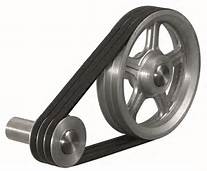
Vee belts (also known as V-belt or wedge rope) solved the slippage and alignment problem. It is now the basic belt for power transmission. They provide the best combination of traction, speed of movement, load of the bearings, and long service life. The V-belt was developed in 1917 by John Gates of the Gates Rubber Company. They are generally endless, and their general cross-section shape is trapezoidal. The “V” shape of the belt tracks in a mating groove in the pulley (or sheave), with the result that the belt cannot slip off. The belt also tends to wedge into the groove as the load increases — the greater the load, the greater the wedging action — improving torque transmission and making the V-belt an effective solution, needing less width and tension than flat belts. V-belts trump flat belts with their small center distances and high reduction ratios. The preferred center distance is larger than the largest pulley diameter, but less than three times the sum of both pulleys. Optimal speed range is 1000–7000 ft/min. V-belts need larger pulleys for their larger thickness than flat belts. They can be supplied at various fixed lengths or as a segmented section, where the segments are linked (spliced) to form a belt of the required length. For high-power requirements, two or more vee belts can be joined side-by-side in an arrangement called a multi-V, running on matching multi-groove sheaves. The strength of these belts is obtained by reinforcements with fibers like steel, polyester or aramid (e.g. Twaron or Kevlar). This is known as a multiple-V-belt drive (or sometimes a “classical V-belt drive”). When an endless belt does not fit the need, jointed and link V-belts may be employed. However they are weaker and only usable at speeds up to 4000 ft/min. A link v-belt is a number of rubberized fabric links held together by metal fasteners. They are length adjustable by disassembling and removing links when needed.
RIBBED BELT
A ribbed belt is a power transmission belt featuring lengthwise grooves. It operates from contact between the ribs of the belt and the grooves in the pulley. Its single-piece structure it reported to offer an even distribution of tension across the width of the pulley where the belt is in contact, a power range up to 600 kW, a high speed ratio, serpentine drives (possibility to drive off the back of the belt), long life, stability and homogeneity of the drive tension, and reduced vibration. The ribbed belt may be fitted on various applications : compressors, fitness bikes, agricultural machinery, food mixers, washing machines, lawn mowers, etc
MULTI-GROOVE BELTS
A multi-groove or poly groove belt is made up of usually 5 or 6 “V” shapes along side each other. This gives a thinner belt for the same drive surface, thus is more flexible, although often wider. The added flexibility offers an improved efficiency, as less energy is wasted in the internal friction of continually bending the belt. In practice this gain of efficiency is overshadowed by the reduced heating effect on the belt, as a cooler-running belt lasts longer in service.
A further advantage of the poly groove belt, and the reason they have become so popular, stems from the ability to be run over pulleys on the un grooved back of the belt. Although this is sometimes done with vee belts and a single idler pulley for tension, a poly groove belt may be wrapped around a pulley on its back tightly enough to change its direction, or even to provide a light driving force.
Any v belt’s ability to drive pulleys depends on wrapping the belt around a sufficient angle of the pulley to provide grip. Where a single-vee belt is limited to a simple convex shape, it can adequately wrap at most three or possibly four pulleys, so can drive at most three accessories. Where more must be driven, such as for modern cars with power steering and air conditioning, multiple belts are required. As the poly groove belt can be bent into concave paths by external idlers, it can wrap any number of driven pulleys, limited only by the power capacity of the belt.
This ability to bend the belt at the designer’s whim allows it to take a complex or “serpentine” path. This can assist the design of a compact engine layout, where the accessories are mounted more closely to the engine block and without the need to provide movable tensioning adjustments. The entire belt may be tensioned by a single idler pulley
FILM BELTS
Though often grouped with flat belts, they are actually a different kind. They consist of a very thin belt (0.5-15 millimeters or 100-4000 micrometres) strip of plastic and occasionally rubber. They are generally intended for low-power (10 hp or 7 kW), high-speed uses, allowing high efficiency (up to 98%) and long life. These are seen in business machines, printers, tape recorders, and other light-duty operations
TIMING BELTS
Read More
Timing belts, (also known as toothed, notch, cog, or synchronous belts) are apositive transfer belt and can track relative movement. These belts have teeth that fit into a matching toothed pulley. When correctly tension-ed, they have no slippage, run at constant speed, and are often used to transfer direct motion for indexing or timing purposes (hence their name). They are often used in lieu of chains or gears, so there is less noise and a lubrication bath is not necessary. Camshafts of automobiles, miniature timing systems, and stepper motors often utilize these belts. Timing belts need the least tension of all belts, and are among the most efficient. They can bear up to 200 hp (150 kW) at speeds of 16,000 ft/min.
Timing belts with a helical offset tooth design are available. The helical offset tooth design forms a chevron pattern and causes the teeth to engage progressively. The chevron pattern design is self-aligning. The chevron pattern design does not make the noise that some timing belts make at idiosyncratic speeds, and is more efficient at transferring power (up to 98%).
Disadvantages include a relatively high purchase cost, the need for specially fabricated toothed pulleys, less protection from overloading and jamming, and the lack of clutch action